Sophia Vitela — Wimberley, Texas
About the Project
This storytelling project, led by Jazmin Storrs through her internship with Mobilize Green, offers a human perspective to the environmental challenges shaping life across Texas. From the Panhandle to South Texas, from coastal towns to Hill Country communities, interviews capture how people experience heat, drought, hurricanes, floods, and strong winds in their own backyards. Too often, these realities are contained in statistics, while the lived stories remain unheard. By centering personal voices, the project reminds us that whether facing storms, droughts, or flooding, we are bound by a common thread: our humanity. Each story calls us to listen with empathy, see beyond the data, and recognize that caring for the environment is inseparable from caring for one another.
Protecting Earth’s Sacred Gems
by Jazmin Storrs
From the fading waters of Jacob’s Well to the fires that nearly reached her home, Sophia shares how climate change is reshaping Central Texas — and how her community is rising to meet it.
About Sophia Vitela
Sophia Vitela is a first-year Climate System Science student at the University of Texas at Austin and a 2024-2025 Young Texan Ambassador for Central Texas. Originally from Austin and now living near Wimberley, she blends personal experience with scientific insight. From creating a pollinator garden at her local library to evacuating during wildfires, Sophia’s work is rooted in love for the land. She’s proven to be a decorated communicator through her AP Scholar status, state debate championships, and PEC Youth Delegate recognition, using her voice to inspire local action and raise awareness.


What impacts have you observed in your environment?
Sophia has watched treasured landmarks in her community change irretrievably. She describes the decline of Jacob’s Well, which was once a clear, sacred spring and popular swimming spot, with a tone of both grief and urgency.
“Within the last five years, Jacob’s Well, a local treasure that used to attract thousands of tourists, has nearly completely dried up. You can see algae where clear water used to be, and they’ve had to put up no-swimming warnings because it’s become so toxic. It’s not just about losing a recreational spot, but about losing a sacred community gem that has been important for hundreds of years.”

Before and After: Jacob’s Well in Wimberley, Texas: Once a popular swimming hole, now sits eerily dry due to prolonged drought, reflecting an emblem of vanishing waters in a warming climate.
She explains that this isn’t just a natural shift — it’s the result of systemic mismanagement, worsening heat, and unsustainable water extraction.
“It’s not just about the rain but also how water is being managed. The pumping system operated by Aqua Pepsi and the water distribution by Texas companies can’t retain water properly. The increasing heat has also taken a significant toll. These three factors have combined to essentially destroy this community gem.”
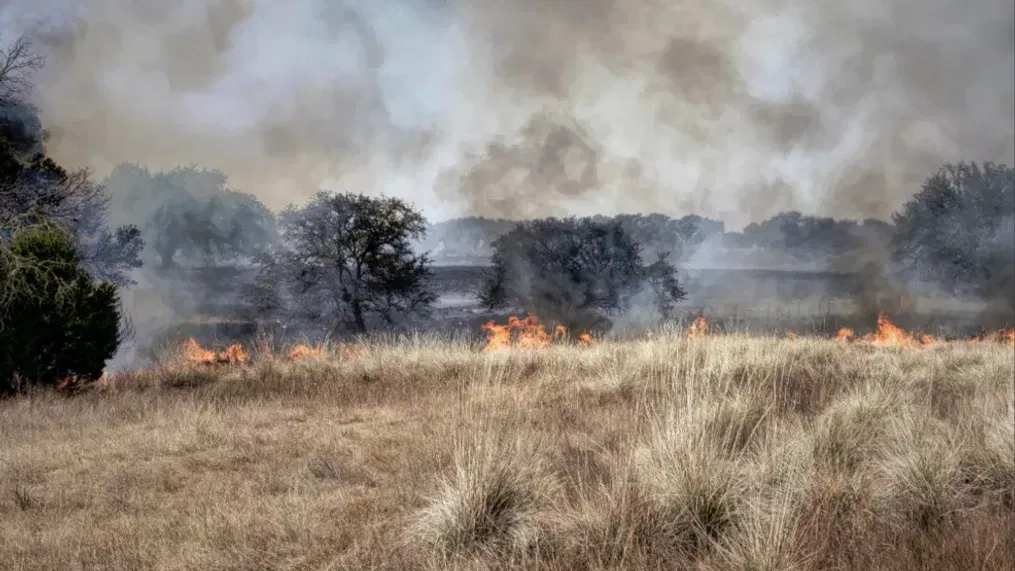
Photo credit: Larry Alford
Then came the wildfire. When the Smoke Rider fire erupted, it threatened homes and silenced the natural world.
“The Smoke Rider wildfire came within a quarter mile of my house. We had to pack everything up, ready to evacuate at a moment’s notice. The fire burned through an area that was predominantly filled with trees and wildlife. For months after, the landscape was completely barren. No birds, no deer, just flat, burned land. It took a long time for anything to grow back, especially with the drought that followed.
“The fire killed around 100,000 wildlife animals and forced local shelters to transfer their animals. It was a firsthand experience of how the climate crisis can devastate a community.”
”“When the wildfires came close to our home, churches opened their doors, people fostered animals, and everyone came together to support each other. Even when the landscape is destroyed, the community's spirit remains strong.”
How has this affected your community?
Despite the devastation, Sophia highlights the strength of her community in moments of crisis. When the fires came, neighbors didn’t hesitate to step in.
The loss of Jacob’s Well left not only an environmental scar, but a cultural one. Sophia speaks to the emotional weight of watching a beloved space fade from memory.
“With Jacob’s Well drying up, the community is deeply affected. It’s not just a water source, but a childhood memory for many locals. People are constantly discussing on Facebook forums, trying to understand why this is happening. The loss is not only environmental, but personal too. Tourism has dropped, and a place that was once a vibrant gathering spot is now almost unrecognizable.”

Jacob’s Well in Wimberley is shown at dangerously low levels, leading to swimming closures during the usual season.
Still, Sophia finds hope in the way people come together and how pain becomes fuel for action.
“What’s remarkable is how these events have united us. Whether it’s a wildfire threatening our homes or a beloved water source disappearing, the community comes together. We’re not just surviving these climate challenges; we’re facing them collectively.”
How have you adapted to these circumstances?
Sophia’s approach to adaptation is practical, but also deeply rooted in community care. She details the preparation her family now takes as wildfires and heat waves become more common:
“As these disasters continue to happen, two things become clear: climate change is driving these events, and your community will always have your back. We’ve learned to be prepared by packing up insurance documents, having evacuation plans ready, and monitoring fire trackers and wind patterns.”
But she also points to a deeper form of adaptation: resilience, and a commitment to helping one another.
“But more importantly, we’ve learned resilience. When the land changes, when Jacob’s Well dries up or wildfires threaten our homes, we adapt. We support each other, we foster animals, we provide shelter, we keep our community strong. It’s not about fighting these changes alone, but facing them together.”
Looking toward the future
Sophia’s dream is simple: to preserve the places that made her who she is.
“I hope to preserve these once-in-a-lifetime natural gems for future generations. It would be a disservice to simply look at these places and forget they exist. My goal is to help people understand that these environments aren’t just resources, but crucial ecosystems that support people, animals, and plants.”
Furthermore, she believes education and action can shift the narrative away from disposability toward protection.
“By studying climate science at UT, I want to contribute to understanding and mitigating climate change, starting with local actions in our community. We need to show people that these places are precious and worth protecting, not disposable landscapes we can just abandon.”

Sophia Vitela and her team pose for a photo after creating a pollinator garden at the Wimberley Village Public Library during her 2024–2025 term as a Young Texan Ambassador.
Why Care for the Environment?
For Sophia, environmental care is about honoring the land and the life it holds now and for the future.
“By caring for our environment, we’re facilitating a way for future generations to learn about the history of the land they stand on. These aren’t just landscapes, they’re living, breathing ecosystems that deserve our respect and protection.”
”As the next generation, we have to be the ones picking up the pieces and creating change. It starts small in our communities, in our local governments, by raising awareness and showing people that every action matters. We're not going to solve climate change overnight, but we can make a difference right where we are.
Call to Action
Environmental change is an effort that starts locally with everyday people stepping up.
“We can’t just sit back and watch our environment deteriorate. It’s about taking local action. Whether that’s creating pollinator gardens, participating in community cleanups, or putting public pressure on local officials and companies that mismanage our natural resources.”

Jazmin Storrs
Jazmin Storrs is a student at the University of Texas at Austin, double majoring in International Relations and Humanities Honors, where she has designed a concentration titled Climate Policy, Human Rights, and the Media. As a Rapoport Community Service Scholar, Jazmin is recognized for her public service. She works as an Election Clerk to support voter access and recently traveled to Washington, D.C. to advocate for underserved communities.
As a Mobilize Green Intern, Jazmin supports Keep Texas Beautiful by leading storytelling on Texans’ environmental experiences. She is also the Climate Lead for UN Young Professionals and Vice Chair for Central Texas Model United Nations.
A violinist of over ten years, Jazmin earned 1st place at the 2022 New York National Orchestra Cup and performed at the International Midwest Clinic in 2023. Passionate about humanizing climate policy, Jazmin is dedicated to ensuring that everyday voices are represented in institutional spaces.